“Third Way” The New Yorker on the rise of 3D

In the March 8, 2010 issue of the venerable New Yorker magazine, film critic Anthony Lane has a long story on the state of 3D called “Third Way” and subtitled “The history of 3-D from stereoscope to Avatar.”

Published as Avatar was shattering all box office records, the article delves into the the history of 3D as an art form and poses the tantalizing question:

“Faced with the thought of a 3-D “Casablanca,” one is torn between outrage at such blind desecration and a sneaking wish to know—well, what the hell would it look like?”

Excellent reading and a well-sourced background for anyone considering some of the loftier cultural and historic aspects of 3D.

From the New Yorker. Photograph by Miles Aldridge.


Stop the Presses! 3D actually GOOD for children?

This should make some industry insiders very very happy. The American Optometric Association (AOA) is releasing a report called 3D in the Classroom subtitled “See Well, Learn Well”. (See the announcement by clicking here).

Contrary to recent gloom-and-doom reports about the perils of 3D—including headaches, nausea, and damage to the vision of young children—the AOA is asserting that its research shows not only does use of 3D significantly enhance learning in the classroom, it’s useful in early identification of vision problems for early intervention and treatment. According to the AOA:

“…New 3D opportunities are underscored by two essential facts, 1) children often learn faster and retain more information in the 3D environment, and 2) the ability to perceive 3D and learn in 3D requires precise elements of ‘vision fitness’. Importantly, 3D vision fitness skills associated with eye alignment, eye tracking, and balanced and corrected refractive errors are also associated with improved overall reading and learning abilities.”

The announcement continues:

“The recent emergence of innovative 3D presentation technologies and 3D content in movie theaters, in the home, in video games and now in the classroom , perhaps surprisingly, provides  a unique public health opportunity. The ability to perceive depth in a 3D presentation – known as ‘stereopsis’– turns out to be a highly sensitive test of a range of vision health indicators.  It is much more sensitive than the standard eye chart that has been in use for 150 years, because it requires that both eyes function in a coordinated manner, as they converge, focus and track the 3D image.”

Variety has an excellent article by Michael Sullivan putting this into context for the high stakes emerging 3D business which ranges far beyond education to encompass entertainment, advertising, and gaming.  Addressing industry warning labels (Nintendo 3DS for example) he says:

“AOA began speaking out after Nintendo attached a warning on its new 3DS stating that the effect should not be used for children younger than 6. In a statement, the AOA disputed that assertion, saying, ‘Since vision develops from birth, it is crucial to uncover the type of vision disorders that may interfere with Nintendo 3D viewing at an early age. Accordingly, children younger than 6 can use the 3DS in 3D mode if their visual system is developing normally.’ Labels on most 3DTV sets also warn against prolonged viewing, despite the fact that there is no medical evidence that substantiates these warnings.”

My opinion: this is closer to a credible scientific insight than the alarmist news reports that have been proliferating recently.  But I am filing this under “Business of 3D” as well as “Science of 3D” because, well, I’m essentially a skeptic.  Debates around the dangers of smoking and climate change teach us that it’s not enough to see what is being said—it’s important to always see who is saying it and what’s in it for them.

So far, however, the pedigree of this report looks excellent and that’s great news for the 3D industry.  Stay tuned.

UPDATE! the report is available online here.

3Deelicious! “Kiss Me Kate”

With this post I’m adding a category called “3Deelicious!” to collect some of the more fun, miscellaneous items out there in the wonderful world of 3D. I hope you enjoy them.

Did you know that the fabulous 50s musical Kiss Me Kate was shot and released in 3D as well as 2D?

Unfortunately it’s contraband.  A friend in the industry has it and has promised to let me see it.  I can’t wait.  Meanwhile the following clip is available on YouTube but on a 3D laptop it looks pretty messy.

Why is this a big deal? For those of us who have mostly seen zombies hacked to death over and over and over and OVER the idea of having something a delectable as Bob Fosse’s “specialty dance” preserved in 3D is tantalizing.

Here’s a plain old YouTube clip, just for fun.  Fosse’s section (which he choreographed and danced with Carol Haney starts at 2:34).


Debating 3D #2: Roger Ebert “I Hate 3D”

Vintage Roger Ebert from Newsweek back in 2010: Why I Hate 3-D (And You Should Too)”

This is a particularly eloquent and thoughtful criticism of 3D from a famous lover of films. Film critic, historian, and beloved blogger Roger Ebert summarizes the shortcomings of 3D from his point of view: venal Hollywood studios squeezing extra money out of audiences, charging premium prices for sub-premium product, compromised light levels, not suited to adult storytelling, headaches/nausea, nefarious equipment vendors trying to make a buck, and more.

Ebert cares passionately about film and makes an excellent case for higher frame rates, as well as better quality storytelling.

Published in Newsweek magazine and The Daily Beast web site, May 9, 2010, this article is an important part of the ongoing debate.  Click here to read then entire piece.

Film legend Bernardo Bertolucci’s 3D debut

ROME: Over drinks at a sidewalk cafe in Campo de Fiori, a friend in the film industry told me Bernardo Bertolucci is working on a 3D film.  He’s confined to a wheelchair, she said, but planning his next work based on a novella by Niccolò Ammaniti called Io e Te (Me and You).  The story has two characters, takes place in one room, and will be shot in 3D.

Bertolucci (The Last Emperor, 1900, The Conformist, Last Tango in Paris) is one of the greatest fine arts filmmakers ever and a hero of mine—this is exciting news.

I did a little checking and found this article (behind Variety’s annoying signup): http://bit.ly/qBHEf1  and this breathier Entertainment Weekly post: http://bit.ly/psQmds both with tantalizing details.

From EW:

 “Why is 3-D considered good only for horror or science fiction?” He began to imagine his favorite movies, classics of European art-cinema, given the stereoscopic treatment.

BertolucciImage Credit: Lionel Cironneau/AP Images
“I thought, ‘If 8 ½ by Fellini was in 3-D, wouldn’t it be great?’” Bertolucci said. “Another film that could have been great in 3-D was [Ingmar] Bergman’sPersona. How fascinating, this movie with close-ups of the two actors.”

German filmmakers Werner Herzog and Wim Wenders have experimented with 3-D documentaries, but this is the first time the technique will have been tried on an intimate drama by a director of such renown.

This should be interesting!

Trailer: Titanic 3D

Yep.  Box office record-breaking Titanic is back for more.  This time in 3D. Painstakingly converted (I heard James Cameron say it cost $18 million to do) it will be released in April 2012, timed to coincide with the 100th anniversary of the sailing of the doomed ocean liner.

Here’s a trailer, in 2D, to get you in the mood!

Trailer: Flying Monsters 3D

Sir David Attenborough’s new film Flying Monsters 3Dis a documentary utilizing live action (Sir David and other experts) as well as CGI to bring fossils dancing to life and recreate the astounding creatures known as pterosaurs. It is geeky fun, kids will love it and it will make you think.


Titanic and Pterosaurs in 3D at IBC 2011

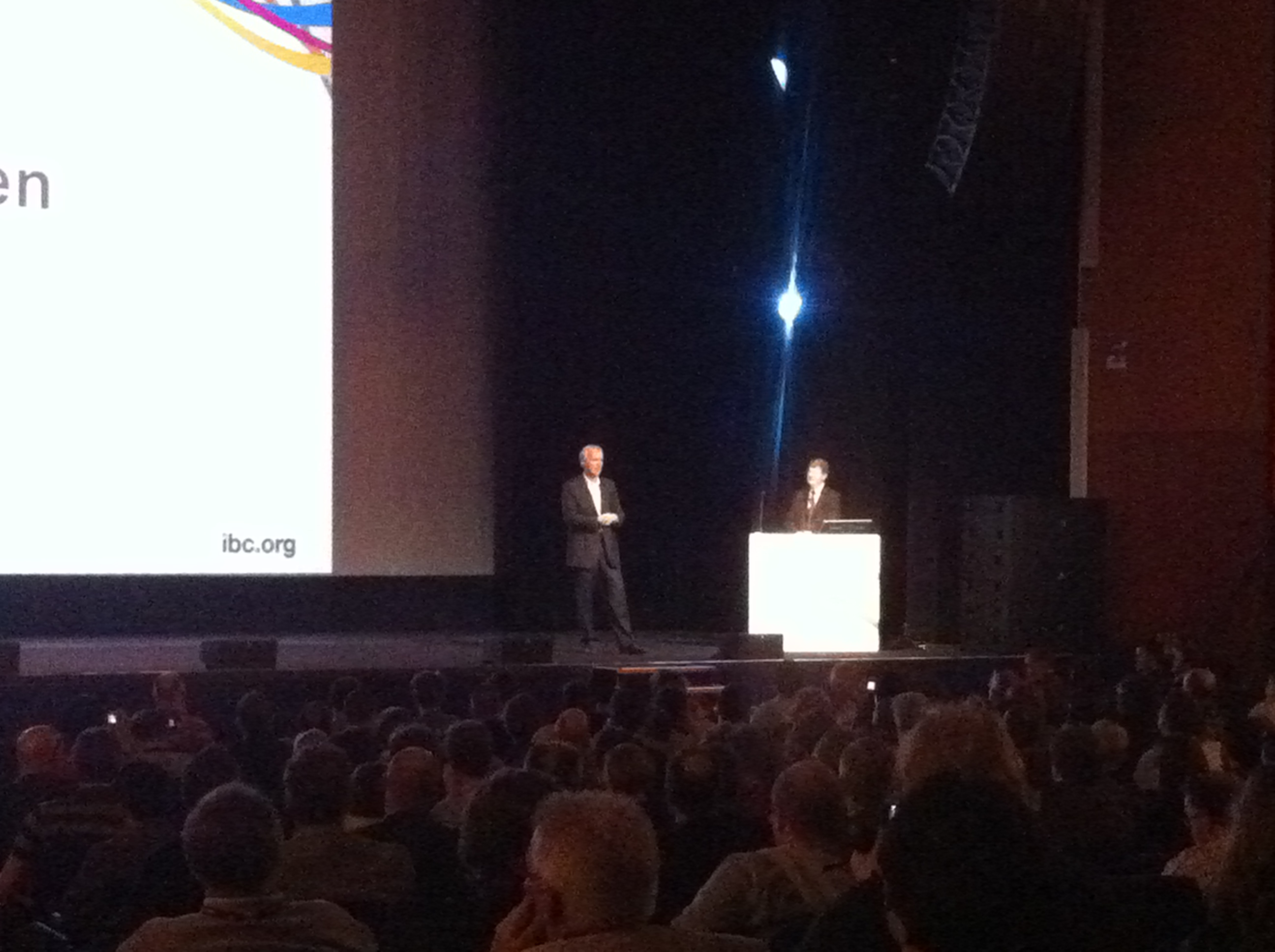
Amsterdam, September 12, 2011: IBC Theatre.  James Cameron and Vincent Pace showed off 18 minutes of Titanic converted to 3D as well as clips from their upcoming Cirque du Soleil film, while noted documentary film maker Sir David Attenborough screened his Flying Monsters 3D.

Aimed at broadcasters, the evening started with Don Shaw from Christie Digital (the projector people) talking about the importance of higher frame rates for making 3D smoother—minimizing or eliminating “strobing” and other annoying effects. (More about frame rates another time). He showcased technology innovations—an end-to-end solution for broadcasting live alternative content in 3D to theatrical venues with greater ease (I’m very proud to say that the company where I work, International Datacasting, is part of the solution presented, as well as our partners at Sensio Technologies. My colleagues helped pull the demonstration off without a hitch, bravo!)

But the highlight of the event naturally was watching movies and looking to see if the technical and artistic bar has moved forward. James Cameron took the stage (amid a bunch of awards hoopla you can follow elsewhere) and preached the gospel of 3D: “Last year 21% all movie revenue came from 3D,” “I will shoot every movie going forward in 3D”, and my favorite: “Let me tell you about my new movie coming April 5, 2012, Titanic.”

Yes, Titanic is being converted to 3D with a release scheduled to coincide with the 100th anniversary of the ship’s sailing (or as Cameron called it a “trifecta of good marketing.”)  Cameron emphasized that it is always preferable to shoot in 3D rather than convert a film but where it’s not possible “there’s conversion and there’s conversion” saying he wouldn’t have spent $18 million adding 3D if he didn’t think the results would be worth it.

James Cameron at IBC Big Screen, September 12, 2011 (photo: Diana Cantu's iPhone)

Hollywood is rushing to convert 2D films to 3D with varying degrees of success.  The Titanic footage looked smooth and watchable.  The Cirque du Soleil footage which was captured in 3D is gorgeous. The 3D is subtle and restrained, it adds aesthetically to the content. I’ve seen the Cirque shows the clips were taken from and the 3D actually improved on them.

Flying Monsters 3D is a documentary by Sir David Attenborough, examining fossils of early flying dinosaurs or pterosaurs, and their evolution up to extinction.  With clever mingling of CGI, live action and 3D the film makes a serious subject a bit more whimsical and accessible.  The 3D looked good and lends itself well to scenes with flying.

The event was designed to help win over broadcasters to the merits of 3D and reassure them that the technology is catching up with promises.  Cameron’s emphasis on new dual work flow capabilities (shooting 2D and 3D simultaneously) helps. Live alternative programming and 3D television are both getting better, fast.  That’s a message broadcasters are starting to consider.

3D Lands at Schipol Airport

Arriving in Amsterdam the other morning (after a three-legged overnight flight) we were surprised and impressed to see a big  3D oops “6D” film/simulator/ride set up at Schipol Airport.  Colorful, shiny, with room for a dozen or so patrons to be strapped into bright yellow seats with red 3D glasses.  There’s a 3D screen (two Panasonic beamers with polarizing filters–top and bottom not side-by-side if you are interested). The “6D” refers to seats that move and other bells & whistles to augment and simulate the visual experience on the screen with tactile stimuli.

For €5 one can choose between a couple of titles (“Canyon Coaster” is what the gentleman recommended to us). Unfortunately after a transatlantic redeye flight the only title I was interested in was “Shower and Coffee” which they didn’t have so we declined.

We promised to stop by on our way out of town.  They have a high traffic spot by the front door but not with so much light as to make it unwatchable. There weren’t any customers when we were there–it’s awkward catching people on their way out or conversely on their way in before checkin, but it’s an interesting experiment.

Part of me worries that these are the products that give 3D a bad name, reinforcing that it’s a tool reserved for trying to make people barf.  But the other part of me says “the more the merrier.”

The “6D” simulation ride at Schipol Airport

Dispatch from IBC 2011

IBC 2011 conference and trade show, Amsterdam: James Cameron and Vincent Pace are working the show: evangelizing about 3D, previewing a new Cirque du Soleil 3D film, and calling themselves “myth-busters” on the technical, aesthetic, and business aspects of the industry.  Here’s a video of them  talking about next gen 3D technology, 3D in broadcast, and indulging in some forecasting (glasses-free 3D in three to five years!)

It’s a press conference followed by a brief interview.  Cameron makes the important point:

3D isn’t going to save a bad movie, it’s still going to be storytelling…3D is not a guarantee that you are going to have a great time. You might be watching a very high quality version of a very poor film.

We feel that it’s incumbent on us as 3D practitioners to maintain the highest possible standard. We don’t want the 3D to be the thing that was wrong with the movie. Let the movie be a dog but don’t let the 3D be the reason you didn’t like it.